True NorthPaul Theroux
- Genre: Essays & Memoirs
- Publish Date: September 22, 2026
- Publisher: Mariner Books
- Apple Books | $14.99Amazon Kindle


The most popular and best selling travel memoirs and essays at the Apple iBookstore. Chart updated daily.
Chart list of the top travel essay ebook best sellers was last updated:
Related Chart: Travel and Adventure Audiobooks
1

True NorthPaul Theroux
A Toronto Star bestseller Acclaimed, bestselling author and "“master of modern travel writing” ( Wall Street Journal) Paul Theroux turns his gaze to Canada in a sweeping, personal journey. For more than half a century, Paul Theroux has traveled the globe and chronicled its far corners with curiosity, wit, and an unflinching eye. With True North , his twelfth travel book, he turns that eye to a country that has long been his quiet neighbor: Canada. What begins as the completion of a North American road trip trilogy becomes something more personal. Theroux traces his own ancestral connection to Quebec, where his forebear Antoine Theroux arrived in the 17th century. Theroux meets his Quebcois friends and relations, then travels more widely through remote villages, multicultural cities, and sweeping landscapes that have defined modern Canada. Along the way, he speaks with farmers, refugees, writers like John Irving and Michael Ondaatje, and Indigenous leaders such as Tanya Talaga, listening as Canadians reckon with identity, belonging, and patriotism, often in response to the jabs and provocations of their southern neighbor. From snowbound Ottawa at the height of political protests to the Viking settlement at L'Anse aux Meadows, from Toronto's "ethno-burbs" to Vancouver's Pacific gateway, True North is a panoramic portrait of a vast country both familiar and elusive. It is also a meditation on kinship, migration, and the resilience of a people shaped by history, geography, and challenging weather. With the empathy of a companion and the sharpness of a cultural critic, Theroux delivers a timely, vivid travel narrative that reveals Canada as never before—diverse, unsettled, and alive with stories.
2

A Walk in the WoodsBill Bryson

NEW YORK TIMES BESTSELLER • The classic chronicle of a “terribly misguided and terribly funny” ( The Washington Post ) hike of the Appalachian Trail, from the author of A Short History of Nearly Everything and The Body “The best way of escaping into nature.”— The New York Times Back in America after twenty years in Britain, Bill Bryson decided to reacquaint himself with his native country by walking the 2,100-mile Appalachian Trail, which stretches from Georgia to Maine. The AT offers an astonishing landscape of silent forests and sparkling lakes—and to a writer with the comic genius of Bill Bryson, it also provides endless opportunities to witness the majestic silliness of his fellow human beings. For a start there’s the gloriously out-of-shape Stephen Katz, a buddy from Iowa along for the walk. But A Walk in the Woods is more than just a laugh-out-loud hike. Bryson’s acute eye is a wise witness to this beautiful but fragile trail, and as he tells its fascinating history, he makes a moving plea for the conservation of America’s last great wilderness. An adventure, a comedy, and a celebration, A Walk in the Woods is a modern classic of travel literature. NOW A MAJOR MOTION PICTURE
3

What Really Happens in VegasJames Patterson & Mark Seal

The world's #1 bestselling author shows the real Vegas in a dazzling journey through Sin City. What happens in Vegas stays in Vegas—until now. In What Really Happens in Vegas , James Patterson and Vanity Fair contributing editor Mark Seal transport readers from the thrill of adrenaline-fueled vice to the glitter of A-list celebrity and entertainment. Las Vegas is on Luxury Standard Time: every clock in the airport is a Rolex. No dream is too big, no wish is too small—the VIP hosts in Vegas fulfill guests’ every (legal) desire. Jackpots hit when least expected. The Nevada Gaming Control Board has days to find a man who unknowingly won over $200,000 at the slots. The inventor of the Elvis impersonator wedding and the drive-thru wedding has performed hundreds of marriages—and believes in them all. Glamorous yogis take a helicopter across the desert to the Valley of Fire, where they perform sun salutations to the glory of Las Vegas. A gambling VIP “whale” loses $1 million at the casinos, yet still leaves saying, "Had a great time. I'll be back". “Wild and wonderful…The magic of Sin City doesn’t just happen. Patterson and Seal tell its secrets in beautifully presented snippets that often overlap not just surprisingly, but charmingly too.” — Telegraph (UK)
4
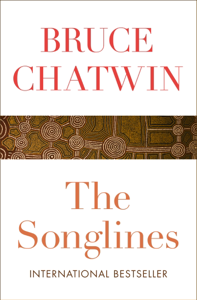
The SonglinesBruce Chatwin

International Bestseller: The famed travel writer and author of In Patagonia traverses Australia, exploring Aboriginal culture and song—and humanity's origins. Long ago, the creators wandered Australia and sang the landscape into being, naming every rock, tree, and watering hole in the great desert. Those songs were passed down to the Aboriginals, and for centuries they have served not only as a shared heritage but as a living map. Sing the right song, and it can guide you across the desert. Lose the words, and you will die. Into this landscape steps Bruce Chatwin, the greatest travel writer of his generation, who comes to Australia to learn these songs. A born wanderer, whose lust for adventure has carried him to the farthest reaches of the globe, Chatwin is entranced by the cultural heritage of the Aboriginals. As he struggles to find the deepest meaning of these ancient, living songs, he is forced to embark on a much more difficult journey—through his own history—to reckon with the nature of language itself. Part travelogue, part memoir, part novel, The Songlines is one of Bruce Chatwin's final—and most ambitious—works. From the author of the bestselling In Patagonia and On the Black Hill , a sweeping exploration of a landscape, a people, and one man's history, it is the sort of book that changes the reader forever. This ebook features an illustrated biography of Bruce Chatwin including rare images and never-before-seen documents from the author's estate.
5

A Course Called IrelandTom Coyne

An epic Celtic sojourn in search of ancestors, nostalgia, and the world?s greatest round of golf In his thirties, married, and staring down impending fatherhood, Tom Coyne was well familiar with the last refuge of the adult male: the golfing trip. Intent on designing a golf trip to end all others, Coyne looked to Ireland, the place where his father had taught him to love the game years before. As he studied a map of the island and plotted his itinerary, it dawned on Coyne that Ireland was ringed with golf holes. The country began to look like one giant round of golf, so Coyne packed up his clubs and set off to play all of it. And since Irish golfers didn?t take golf carts, neither would he. He would walk the entire way. A Course Called Ireland is the story of a walking- averse golfer who treks his way around an entire country, spending sixteen weeks playing every seaside hole in Ireland and often battling through all four seasons in one Irish afternoon. Coyne plays everything from the top-ranked links in the world to nine-hole courses crowded with livestock. Along the way, he searches out his family?s roots, discovers that a once-poor country has been transformed by an economic boom, and finds that the only thing tougher to escape than Irish sand traps are Irish pubs. By turns hilarious and poetic, A Course Called Ireland is a magnificent tour of a vibrant land and a paean to the world?s greatest game.
6

World TravelAnthony Bourdain & Laurie Woolever

A guide to some of the world’s most fascinating places, as seen and experienced by writer, television host, and relentlessly curious traveler Anthony Bourdain Anthony Bourdain saw more of the world than nearly anyone. His travels took him from the hidden pockets of his hometown of New York to a tribal longhouse in Borneo, from cosmopolitan Buenos Aires, Paris, and Shanghai to Tanzania’s utter beauty and the stunning desert solitude of Oman’s Empty Quarter—and many places beyond. In World Travel, a life of experience is collected into an entertaining, practical, fun and frank travel guide that gives readers an introduction to some of his favorite places—in his own words. Featuring essential advice on how to get there, what to eat, where to stay and, in some cases, what to avoid, World Travel provides essential context that will help readers further appreciate the reasons why Bourdain found a place enchanting and memorable. Supplementing Bourdain’s words are a handful of essays by friends, colleagues, and family that tell even deeper stories about a place, including sardonic accounts of traveling with Bourdain by his brother, Christopher; a guide to Chicago’s best cheap eats by legendary music producer Steve Albini, and more. Additionally, each chapter includes illustrations by Wesley Allsbrook. For veteran travelers, armchair enthusiasts, and those in between, World Travel offers a chance to experience the world like Anthony Bourdain.
7

AmericanaHampton Sides

Harley-Davidson bikers • Grand Canyon river rats • Mormon archaeologists • Spelling bee prodigies • For more than fifteen years, the bestselling, award-winning author of Blood and Thunder and Ghost Soldiers has traveled widely across the continent exploring the America that lurks just behind the scrim of our mainstream culture. This sparkling mosaic of our country, in all its wild and poignant charm, “may be the best road trip you’ll ever take—full of strange vision, hilarious detours, and sudden beauty in unlikely places” ( The New Yorker ). Reporting for Outside , The New Yorker , and NPR, among other national media, the award-winning journalist has established a reputation not only as a wry observer of the contemporary American scene but also as one of our more inventive and versatile practitioners of narrative non-fiction. In these two dozen pieces, collected here for the first time, Sides gives us a fresh, alluring, and at times startling America brimming with fascinating subcultures and bizarre characters who could live nowhere else. Following Sides, we crash the redwood retreat of an apparent cabal of fabulously powerful military-industrialists, drop in on the Indy 500 of bass fishing, and join a giant techno-rave at the lip of the Grand Canyon. We meet a diverse gallery of American visionaries— from the impossibly perky founder of Tupperware to Indian radical Russell Means to skateboarding legend Tony Hawk. We retrace the route of the historic Bataan Death March with veterans from Sides’ acclaimed WWII epic, Ghost Soldiers . Sides also examines the nation that has emerged from the ashes of September 11, recounting the harrowing journeys of three World Trade Center survivors and deciding at the last possible minute not to "embed" on the Iraqi front-lines with the U.S. Marines.
8

Goodbye to a RiverJohn Graves

In the 1950s, a series of dams was proposed along the Brazos River in north-central Texas. For John Graves, this project meant that if the stream’s regimen was thus changed, the beautiful and sometimes brutal surrounding countryside would also change, as would the lives of the people whose rugged ancestors had eked out an existence there. Graves therefore decided to visit that stretch of the river, which he had known intimately as a youth. Goodbye to a River is his account of that farewell canoe voyage. As he braves rapids and fatigue and the fickle autumn weather, he muses upon old blood feuds of the region and violent skirmishes with native tribes, and retells wild stories of courage and cowardice and deceit that shaped both the river’s people and the land during frontier times and later. Nearly half a century after its initial publication, Goodbye to a River is a true American classic, a vivid narrative about an exciting journey and a powerful tribute to a vanishing way of life and its ever-changing natural environment.
9

The Great Railway BazaarPaul Theroux

The acclaimed author recounts his epic journey across Europe and Asia in this international bestselling classic of travel literature: "Compulsive reading" (Graham Greene). In 1973, Paul Theroux embarked on a four-month journey by train from the United Kingdom through Europe, the Middle East, and Southeast Asia. In The Great Railway Bazaar , he records in vivid detail and penetrating insight the many fascinating incidents, adventures, and encounters of his grand, intercontinental tour. Asia's fabled trains—the Orient Express, the Khyber Pass Local, the Frontier Mail, the Golden Arrow to Kuala Lumpur, the Mandalay Express, the Trans-Siberian Express—are the stars of a journey that takes Theroux on a loop eastbound from London's Victoria Station to Tokyo Central, then back from Japan on the Trans-Siberian. Brimming with Theroux's signature humor and wry observations, this engrossing chronicle is essential reading for both the ardent adventurer and the armchair traveler.
10

Lost JapanAlex Kerr

An enchanting and fascinating insight into Japanese landscape, culture, history and future. Originally written in Japanese, this passionate, vividly personal book draws on the author's experiences in Japan over thirty years. Alex Kerr brings to life the ritualized world of Kabuki, retraces his initiation into Tokyo's boardrooms during the heady Bubble Years, and tells the story of the hidden valley that became his home. But the book is not just a love letter. Haunted throughout by nostalgia for the Japan of old, Kerr's book is part paean to that great country and culture, part epitaph in the face of contemporary Japan's environmental and cultural destruction. Winner of Japan's 1994 Shincho Gakugei Literature Prize. Alex Kerr is an American writer, antiques collector and Japanologist. Lost Japan is his most famous work. He was the first foreigner to be awarded the Shincho Gakugei Literature Prize for the best work of non-fiction published in Japan.
11

Under Another SkyCharlotte Higgins

The author and classics scholar shares " a delightful, deeply informed recounting of her journeys across Britain in search of its ancient Roman past" ( Kirkus , starred review). What does Roman Britain mean to us now? How were its physical remains rediscovered and made sense of? How has it been reimagined, in story and song and verse? Sometimes on foot, sometimes in a magnificent, if not entirely reliable, VW camper van, Charlotte Higgins sets out to explore the ancient monuments of Roman Britain. She explores the land that was once Rome's northernmost territory and how it has changed since the years after the empire fell. Under Another Sky invites readers to see the British landscape, and British history, in an entirely fresh way: as indelibly marked by how the Romans first imagined and wrote, these strange and exotic islands, perched on the edge of the known world, into existence. Shortlisted for the Samuel Johnson Prize
12

Italian HoursHenry James & John Auchard

"The charm of certain vacant grassy spaces, in Italy, overfrowned by masses of brickwork that are honeycombed by the suns of centuries, is something that I hereby renounce once for all the attempt to express; but you may be sure that whenever I mention such a spot enchantment lurks in it." —Henry James In these essays on travels in Italy written from 1872 to 1909, Henry James explores art and religion, political shifts and cultural revolutions, and the nature of travel itself. James's enthusiastic appreciation of the unparalleled aesthetic allure of Venice, the vitality of Rome, and the noisy, sensuous appeal of Naples is everywhere marked by pervasive regret for the disappearance of the past and by ambivalence concerning the transformation of nineteenth-century Europe. John Auchard's lively introduction and extensive notes illuminate the surprising differences between the historical, political, and artistic Italy of James's travels and the metaphoric Italy that became the setting of some of his best-known works of fiction. This edition includes an appendix of James's book reviews on Italian travel-writing. For more than seventy years, Penguin has been the leading publisher of classic literature in the English-speaking world. With more than 1,700 titles, Penguin Classics represents a global bookshelf of the best works throughout history and across genres and disciplines. Readers trust the series to provide authoritative texts enhanced by introductions and notes by distinguished scholars and contemporary authors, as well as up-to-date translations by award-winning translators.
13

Giant StepsKarl Bushby

In Punta Arenas, Chile, in November 1998, Karl Bushby set out on one of the most remarkable journeys of modern times. His plan is as simple as it is extraordinary: to walk up the Americas, across the Bering Strait, through Asia, Russia and Europe, back through the Channel Tunnel and returning to Britain in 2011. It is a journey of remarkable endurance -- 20 miles a day, 3,000 miles a year, 36,000 miles in total. By the time Karl returns, he will have crossed four continents, twenty-five countries, a frozen sea, six deserts and seven mountain ranges. But more than that, unlike other similar expeditions, Karl is attempting it single-handed: no huge support teams, no large sponsorship deals, this is the inspiring true story of a man facing remarkable odds -- and winning.
14

Pasquale's NoseMichael Rips

Everywhere hailed for its quirkiness, its hilarity, its charm, Pasquale's Nose tells the story of a New York City lawyer who runs away to a small Etruscan village with his wife and new baby, and discovers a community of true eccentrics -- warring bean growers, vanishing philosophers, a blind bootmaker, a porcupine hunter -- among whom he feels unexpectedly at home.
15

A Book-lover's Holidays in the OpenTheodore Roosevelt

Theodore Roosevelt's A Book-Lover's Holidays in the Open is a vigorous blend of travel memoir, natural history, and literary reflection, shaped by the authority of a statesman who knew both books and the wild. Framed by a dedication to Archie and Quentin and a foreword that insists true adventure requires courage, vitality, and an open mind, the book presents wilderness travel as a source of renewal, knowledge, and joy. Roosevelt celebrates not only danger and hardship, but also the pleasure of observing, reading, and learning in wild places. Across its chapters, the book ranges from the Grand Canyon, the Navajo Desert, and the Hopi Snake-Dance to Argentina, Chile, Patagonia, the Mississippi bird reserves, and the African veldt. Hunting scenes bring raw frontier drama: hounds tree a mountain lion, a bull moose charges and is killed in self-defense, and the narrator records the skills, risks, and regrets of the chase. Other passages connect modern hunters to prehistoric humanity, comparing African game and hunters such as the Ndorobo to ancient ancestors shaped by lions, elephants, zebras, rhinos, and buffalo. With practical notes, eyewitness accounts, and vivid wildlife observation, the book becomes an energetic celebration of the open air. This edition has been fully restored with modern typesetting, custom cover design.
16

Journey Across JapanChris Broad

From the author of the Number one bestseller Abroad in Japan THE NEW INSTANT SUNDAY TIMES BESTSELLER! GET READY TO EXPLORE JAPAN LIKE NEVER BEFORE… Beyond its neon-lit megacities lies a nation made up of forty-seven distinct prefectures. Each one has its own story to tell, shaped by centuries of squabbling lords, impenetrable topography and fierce local pride. On his quest to reveal what lies beyond the beaten paths, Chris Broad takes us through the 47 unique prefectures of the Land of the Rising Sun. Part travelogue, part practical guide and part catalogue of deeply questionable decisions, Journey Across Japan is a voyage into the endless surprises the country has to offer. From the chaos of a morning market to flying a tiny plane over Japan’s most active volcano, to wandering the shores of subtropical islands, Chris uncovers a side of the country few visitors ever see. Whether you’re a Japan neophyte or a seasoned veteran, this book will inspire you to carve out your own story. Readers loved ABROAD IN JAPAN 'Undeniably the best book I've ever read' ***** 'Experience Japan without ever setting foot there' ***** 'A heartfelt, humorous journey into Japan and its culture' ***** 'I 1000000% reccommend it!' ***** 'A must-read for Japan enthusiasts' *****
17

Travels with Charley in Search of AmericaJohn Steinbeck & Jay Parini

An intimate journey across and in search of America, as told by one of its most beloved writers, in a deluxe centennial edition In September 1960, John Steinbeck embarked on a journey across America. He felt that he might have lost touch with the country, with its speech, the smell of its grass and trees, its color and quality of light, the pulse of its people. To reassure himself, he set out on a voyage of rediscovery of the American identity, accompanied by a distinguished French poodle named Charley; and riding in a three-quarter-ton pickup truck named Rocinante. His course took him through almost forty states: northward from Long Island to Maine; through the Midwest to Chicago; onward by way of Minnesota, North Dakota, Montana (with which he fell in love), and Idaho to Seattle, south to San Francisco and his birthplace, Salinas; eastward through the Mojave, New Mexico, Arizona, to the vast hospitality of Texas, to New Orleans and a shocking drama of desegregation; finally, on the last leg, through Alabama, Virginia, Pennsylvania, and New Jersey to New York. Travels with Charley in Search of America is an intimate look at one of America's most beloved writers in the later years of his life—a self-portrait of a man who never wrote an explicit autobiography. Written during a time of upheaval and racial tension in the South—which Steinbeck witnessed firsthand— Travels with Charley is a stunning evocation of America on the eve of a tumultuous decade. This Penguin Classics Deluxe Edition also features French flaps and deckle-edged paper. For more than sixty-five years, Penguin has been the leading publisher of classic literature in the English-speaking world. With more than 1,500 titles, Penguin Classics represents a global bookshelf of the best works throughout history and across genres and disciplines. Readers trust the series to provide authoritative texts enhanced by introductions and notes by distinguished scholars and contemporary authors, as well as up-to-date translations by award-winning translators.
18

On the Hippie TrailRick Steves

A NEW YORK TIMES BESTSELLER Stow away with Rick Steves for a glimpse into the unforgettable moments, misadventures, and memories of his 1978 journey on the legendary Hippie Trail. In the 1970s, the ultimate trip for any backpacker was the storied “Hippie Trail” from Istanbul to Kathmandu. A 23-year-old Rick Steves made the trek, and like a travel writer in training, he documented everything along the way: jumping off a moving train, making friends in Tehran, getting lost in Lahore, getting high for the first time in Herat, battling leeches in Pokhara, and much more. The experience ignited his love of travel and forever broadened his perspective on the world. This book contains edited selections from Rick’s journal and travel photos with a 45-years-later preface and postscript reflecting on how the journey through Turkey, Iran, Afghanistan, Pakistan, India, and Nepal changed his life. You know Rick Steves. Now discover the adventure of a lifetime that made him the travel writer he is today.
19

The Log from the Sea of CortezJohn Steinbeck & Richard Astro

In the waters of the Gulf of California, John Steinbeck and biologist Ed Ricketts embarked on an awe-inspiring journey of science, philosophy, and adventure. In the two years after the 1939 publication of Steinbeck’s masterful The Grapes of Wrath , Steinbeck and his novel increasingly became the center of intense controversy and censorship. In search of a respite from the national stage, Steinbeck and his close friend, biologist Ed Ricketts, embarked on a month-long marine specimen-collecting expedition in the Gulf of California, which resulted in their collaboration on the Sea of Cortez . In 1951, after Ricketts’ death, Steinbeck reissued his narrative portion of the work in memory of his friend and the inspiration for Cannery Row’s “Doc”. This exciting day-by-day account of their journey together is a rare blend of science, philosophy, and high-spirited adventure. This edition features an introduction by Richard Astro. For more than seventy years, Penguin has been the leading publisher of classic literature in the English-speaking world. With more than 1,700 titles, Penguin Classics represents a global bookshelf of the best works throughout history and across genres and disciplines. Readers trust the series to provide authoritative texts enhanced by introductions and notes by distinguished scholars and contemporary authors, as well as up-to-date translations by award-winning translators.
20

The Happy Isles of OceaniaPaul Theroux

The author of The Great Railway Bazaar explores the South Pacific by kayak: "This exhilarating epic ranks with [his] best travel books" ( Publishers Weekly ). In one of his most exotic and adventuresome journeys, travel writer Paul Theroux embarks on an eighteen-month tour of the South Pacific, exploring fifty-one islands by collapsible kayak. Beginning in New Zealand's rain forests and ultimately coming to shore thousands of miles away in Hawaii, Theroux paddles alone over isolated atolls, through dirty harbors and shark-filled waters, and along treacherous coastlines. Along the way, Theroux meets the king of Tonga, encounters street gangs in Auckland, and investigates a cargo cult in Vanuatu. From Australia to Tahiti, Fiji, Easter Island, and beyond, this exhilarating tropical epic is full of disarming observations and high adventure.
21

Blue LatitudesTony Horwitz

New York Times Bestseller: A Pulitzer Prize–winning author retraces the voyages of Captain James Cook: "Alternately hilarious, poignant, and insightful." — Seattle Times Captain James Cook's three epic journeys in the eighteenth century were the last great voyages of discovery. His ships sailed 150,000 miles, from the Arctic to the Antarctic, from Tasmania to Oregon, from Easter Island to Siberia. When Cook set off for the Pacific in 1768, a third of the globe remained blank. By the time he died in Hawaii in 1779, the map of the world was substantially complete. Tony Horwitz, author of Confederates in the Attic , vividly recounts Cook's voyages and the exotic scenes the captain encountered: tropical orgies, taboo rituals, cannibal feasts, human sacrifice. He also relives Cook's adventures by following in his wake to places such as Tahiti, Savage Island, and the Great Barrier Reef to discover Cook's embattled legacy in the present day. Signing on as a working crewman aboard a replica of Cook's vessel, Horwitz experiences the thrill and terror of sailing a tall ship. He also explores Cook the man: an impoverished farm boy who broke through the barriers of his class and time to become the greatest navigator in British history, whose voyages helped create the "global village" we know today. "With healthy doses of both humor and provocative information, the book will please fans of history, exploration, travelogues and, of course, top-notch storytelling." — Publishers Weekly "Horwitz retells the sailor's story and tries to re-create first contact from the point of view of the locals—Tahitians, Maoris, Aleuts, Hawaiians, and others—and judge the legacy of his landing . . . thought-provoking . . . brims with insight." — Booklist "A rollicking read that is also a sneaky work of scholarship . . . new and unexpected insights into the man who out-discovered Columbus. A terrific book." —Nathaniel Philbrick, National Book Award winner and New York Times –bestselling author of In the Heart of the Sea "Well-researched, gripping, and peppered with humorous passages." — St. Louis Post-Dispatch "Part Cook biography, part travelogue, and very much a stroke of genius." — Philadelphia Inquirer
22

Terra IncognitaSara Wheeler

It is the coldest, windiest, driest place on earth, an icy desert of unearthly beauty and stubborn impenetrability. For centuries, Antarctica has captured the imagination of our greatest scientists and explorers, lingering in the spirit long after their return. Shackleton called it "the last great journey"; for Apsley Cherry-Garrard it was the worst journey in the world. This is a book about the call of the wild and the response of the spirit to a country that exists perhaps most vividly in the mind. Sara Wheeler spent seven months in Antarctica, living with its scientists and dreamers. No book is more true to the spirit of that continent--beguiling, enchanted and vast beyond the furthest reaches of our imagination. Chosen by Beryl Bainbridge and John Major as one of the best books of the year, recommended by the editors of Entertainment Weekly and the Chicago Tribune, one of the Seattle Times's top ten travel books of the year, Terra Incognita is a classic of polar literature.
23

Journey to the HebridesSamuel Johnson & James Boswell

Samuel Johnson and James Boswell spent the autumn of 1773 touring the Highlands and Western Islands of Scotland. Both kept detailed notes of their impressions, and later published separate accounts of their journey. These accounts of their great tour contain some of the finest pieces of travel writing ever produced: they are magnificent historical documents and also portraits of two extraordinary personalities. In the vivid prose of these two famous men of letters, the Highlands and the Western Islands spring to life. The juxtaposition of the two very different accounts creates an unsurpassed portrait of a society which was utterly alien to the Europe of the Enlightenment, and which was straining on the brink of calamitous change. These great masterpieces, entertaining, profound, and marvellously readable are also our last chronicles of a lost age and people.
24

The PilgrimagePaulo Coelho & Julia Sanches

A powerful tale of self-discovery and a journey for the ages. Get lost—and found—in the brilliant words of the renowned international bestseller, Paulo Coelho Step into the enriching and enchanting world of The Pilgrimage, a profound parable by Paulo Coelho that marked the beginning of his legacy, paving the way to the renowned The Alchemist . These two works act as complements, with The Pilgrimage offering an intimate glimpse into Paulo Coelho's real-life spiritual transformation during his mystical walk along the fabled Santiago de Compostela route. Part travel memoir and part spiritual guide, The Pilgrimage is a story brimming with universal lessons that resonate with seekers of introspection and literary lovers alike, offering moving insight into living with mindfulness and humility and embracing the human connection to the divine. Coelho’s artful storytelling weaves the extraordinary into the ordinary, illuminating that the profound truths of life often dwell in life’s simplest aspects. As a gateway to Paulo Coelho’s masterpieces, and with over 250,000 copies sold, The Pilgrimage reveals the origins of his philosophy that has inspired millions worldwide to discover their unique inner guidance and overcome fear to build resilience. Whether you’re a fan of Coelho’s enchanting narratives or a first-time reader, this book invites you on an adventure—one that just might lead you to a greater understanding of yourself.
25

N by ERockwell Kent

A classic tale of seafaring, shipwreck, and survival, reprinted from Wesleyan University Press's 1978 facsimile of the original. When artist, illustrator, writer, and adventurer Rockwell Kent first published N by E in a limited edition in 1930, his account of a voyage on a 33-foot cutter from New York Harbor to the rugged shores of Greenland quickly became a collectors' item. Little wonder, for readers are immediately drawn to Kent's vivid descriptions of the experience; we share "the feeling of wind and wet and cold, of lifting seas and steep descents, of rolling over as the wind gusts hit," and the sound "of wind in the shrouds, of hard spray flung on a drum-tight canvas, of rushing water at the scuppers, of the gale shearing a tormented sea." When the ship sinks in a storm-swept fjord within fifty miles of its destination, the story turns to the stranding and subsequent rescue of the three-man crew, salvage of the vessel, and life among native Greenlanders. Magnificently illustrated by Kent's wood-block prints and narrated in his poetic and highly entertaining style, this tale of the perils of killer nor'easters, treacherous icebergs, and impenetrable fog—and the joys of sperm whales breaching or dawn unmasking a longed-for landfall—is a rare treat for old salts and landlubbers alike. "A classic among sailing stories . . . N by E is made all the more enjoyable by more than a hundred of his famous woodblock prints, illustrating in bold detail his masterful account of a true adventure." — The Houston Post
26

Turn Right at Machu PicchuMark Adams

THE NEW YORK TIMES BESTSELLING TRAVEL MEMOIR What happens when an unadventurous adventure writer tries to re-create the original expedition to Machu Picchu? In 1911, Hiram Bingham III climbed into the Andes Mountains of Peru and “discovered” Machu Picchu. While history has recast Bingham as a villain who stole both priceless artifacts and credit for finding the great archeological site, Mark Adams set out to retrace the explorer’s perilous path in search of the truth—except he’d written about adventure far more than he’d actually lived it. In fact, he’d never even slept in a tent. Turn Right at Machu Picchu is Adams’ fascinating and funny account of his journey through some of the world’s most majestic, historic, and remote landscapes guided only by a hard-as-nails Australian survivalist and one nagging question: Just what was Machu Picchu?
27

The Sweet Life in ParisDavid Lebovitz

From the New York Times bestselling author of My Paris Kitchen and L'Appart, a deliciously funny, offbeat, and irreverent look at the city of lights, cheese, chocolate, and other confections. Like so many others, David Lebovitz dreamed about living in Paris ever since he first visited the city and after a nearly two-decade career as a pastry chef and cookbook author, he finally moved to Paris to start a new life. Having crammed all his worldly belongings into three suitcases, he arrived, hopes high, at his new apartment in the lively Bastille neighborhood. But he soon discovered it's a different world en France . From learning the ironclad rules of social conduct to the mysteries of men's footwear, from shopkeepers who work so hard not to sell you anything to the etiquette of working the right way around the cheese plate, here is David's story of how he came to fall in love with—and even understand—this glorious, yet sometimes maddening, city. When did he realize he had morphed into un vrai parisien ? It might have been when he found himself considering a purchase of men's dress socks with cartoon characters on them. Or perhaps the time he went to a bank with 135 euros in hand to make a 134-euro payment, was told the bank had no change that day, and thought it was completely normal. Or when he found himself dressing up to take out the garbage because he had come to accept that in Paris appearances and image mean everything. Once you stop laughing, the more than fifty original recipes, for dishes both savory and sweet, such as Pork Loin with Brown Sugar–Bourbon Glaze, Braised Turkey in Beaujolais Nouveau with Prunes, Bacon and Bleu Cheese Cake, Chocolate-Coconut Marshmallows, Chocolate Spice Bread, Lemon-Glazed Madeleines, and Mocha–Crème Fraîche Cake, will have you running to the kitchen for your own taste of Parisian living.
28

Neither here nor thereBill Bryson

In the early seventies, Bill Bryson backpacked across Europe—in search of enlightenment, beer, and women. He was accompanied by an unforgettable sidekick named Stephen Katz (who will be gloriously familiar to readers of Bryson's A Walk in the Woods). Twenty years later, he decided to retrace his journey. The result is the affectionate and riotously funny Neither Here Nor There.
29

Blue HighwaysWilliam Least Heat-Moon

Hailed as a masterpiece of American travel writing, Blue Highways is an unforgettable journey along our nation's backroads. William Least Heat-Moon set out with little more than the need to put home behind him and a sense of curiosity about "those little towns that get on the map -- if they get on at all -- only because some cartographer has a blank space to fill: Remote, Oregon; Simplicity, Virginia; New Freedom, Pennsylvania; New Hope, Tennessee; Why, Arizona; Whynot, Mississippi." His adventures, his discoveries, and his recollections of the extraordinary people he encountered along the way amount to a revelation of the true American experience.
30
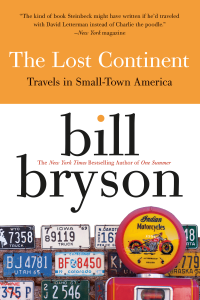
The Lost ContinentBill Bryson

“The kind of book Steinbeck might have written if he’d traveled with David Letterman.” — New York magazine An inspiring and hilarious account of one man’s rediscovery of America and his search for the perfect small town. Following an urge to rediscover his youth, Bill Bryson left his native Des Moines, Iowa, on a cross-country road trip that would take him across 38 states. Lucky for us, he brought a notebook. With a razor wit and a kind heart, Bryson serves up a colorful tale of boredom, kitsch, and beauty when you least expect it. From Times Square to the Mississippi River to Williamsburg, Virginia, Bryson's keen and hilarious search for the perfect American small town is a beloved travelogue straight into the heart and soul of America. He was looking for the idyllic America of his youth. What he found was—something else entirely. Travel Humor: Experience Bryson’s legendary wit as he navigates the kitsch, beauty, and sheer absurdity of America's forgotten corners. Small Town America: Join the hilarious, heartfelt search for the perfect small town—and the stranger-than-fiction reality of what’s really out there. A Nostalgic Journey: A poignant and funny look at coming home, this trip through 38 states is a rediscovery of the country Bryson left behind. Classic Americana: From bizarre tourist traps to the surprising soul of the nation, it’s a loving, laugh-out-loud tribute to the heart of America.
31
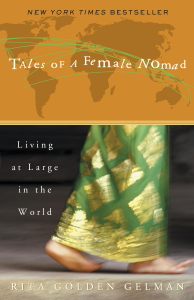
Tales of a Female NomadRita Golden Gelman

The true story of an ordinary woman living an extraordinary existence all over the world. “Gelman doesn’t just observe the cultures she visits, she participates in them, becoming emotionally involved in the people’s lives. This is an amazing travelogue.” — Booklist At the age of forty-eight, on the verge of a divorce, Rita Golden Gelman left an elegant life in L.A. to follow her dream of travelling the world, connecting with people in cultures all over the globe. In 1986, Rita sold her possessions and became a nomad, living in a Zapotec village in Mexico, sleeping with sea lions on the Galapagos Islands, and residing everywhere from thatched huts to regal palaces. She has observed orangutans in the rain forest of Borneo, visited trance healers and dens of black magic, and cooked with women on fires all over the world. Rita’s example encourages us all to dust off our dreams and rediscover the joy, the exuberance, and the hidden spirit that so many of us bury when we become adults.
32

In PatagoniaBruce Chatwin & Nicholas Shakespeare

The masterpiece of travel writing that revolutionized the genre and made its author famous overnight An exhilarating look at a place that still retains the exotic mystery of a far-off, unseen land, Bruce Chatwin’s exquisite account of his journey through Patagonia teems with evocative descriptions, remarkable bits of history, and unforgettable anecdotes. Fueled by an unmistakable lust for life and adventure and a singular gift for storytelling, Chatwin treks through “the uttermost part of the earth”—that stretch of land at the southern tip of South America, where bandits were once made welcome—in search of almost-forgotten legends, the descendants of Welsh immigrants, and the log cabin built by Butch Cassidy. An instant classic upon publication in 1977, In Patagonia is a masterpiece that has cast a long shadow upon the literary world. For more than seventy years, Penguin has been the leading publisher of classic literature in the English-speaking world. With more than 1,700 titles, Penguin Classics represents a global bookshelf of the best works throughout history and across genres and disciplines. Readers trust the series to provide authoritative texts enhanced by introductions and notes by distinguished scholars and contemporary authors, as well as up-to-date translations by award-winning translators.
33

To Build a FireJack London

To Build a Fire and Other Stories is a collection of essential short stories by Jack London. The title tale is the best known of the London short works with its reflection of his experience in the frigid Northwestern Yukon territory with a husky wolf-dog.
34

My Twenty-Five Years in ProvencePeter Mayle

From the moment Peter Mayle and his wife, Jennie, uprooted their lives in England and crossed the Channel permanently, they never looked back. Here the beloved author of A Year in Provence pays tribute to the most endearing and enduring aspects of his life in France—the charming and indelible parade of village life, the sheer beauty, the ancient history. He celebrates the café and lists some of his favorites; identifies his favorite villages, restaurants, and open-air markets; and recounts his most memorable meals. A celebration of twenty-five years of Provençal living—of lessons learned and changes observed—with his final book Mayle has crafted a lasting love letter to his adopted home, marked by his signature warmth, wit, and humor.
35

Bill Bryson's African DiaryBill Bryson

From the author of A Short History of Nearly Everything and The Body comes a travel diary documenting a visit to Kenya. All royalties and profits go to CARE International. In the early fall of 2002, famed travel writer Bill Bryson journeyed to Kenya at the invitation of CARE International, the charity dedicated to working with local communities to eradicate poverty around the world. He arrived with a set of mental images of Africa gleaned from television broadcasts of low-budget Jungle Jim movies in his Iowa childhood and a single viewing of the film version of Out of Africa . (Also with some worries about tropical diseases, insects, and large predators.) But the vibrant reality of Kenya and its people took over the second he deplaned in Nairobi, and this diary records Bill Bryson’s impressions of his trip with his inimitable trademark style of wry observation and curious insight. From the wrenching poverty of the Kibera slum in Nairobi to the meticulously manicured grounds of the Karen Blixen house and the human fossil riches of the National Museum, Bryson registers the striking contrasts of a postcolonial society in transition. He visits the astoundingly vast Great Rift Valley; undergoes the rigors of a teeth-rattling train journey to Mombasa and a hair-whitening flight through a vicious storm; and visits the refugee camps and the agricultural and economic projects where dedicated CARE professionals wage noble and dogged war against poverty, dislocation, and corruption. Though brief in compass and duration, Bill Bryson’s African Diary is rich in irreverent, poignant, and morally instructive observation. Like all of this author’s work, it can make the reader laugh, think, and especially, feel all at the same time.
36

Travels in SiberiaIan Frazier

A Dazzling Russian travelogue from the bestselling author of Great Plains In his astonishing new work, Ian Frazier, one of our greatest and most entertaining storytellers, trains his perceptive, generous eye on Siberia, the storied expanse of Asiatic Russia whose grim renown is but one explanation among hundreds for the region's fascinating, enduring appeal. In Travels in Siberia , Frazier reveals Siberia's role in history—its science, economics, and politics—with great passion and enthusiasm, ensuring that we'll never think about it in the same way again. With great empathy and epic sweep, Frazier tells the stories of Siberia's most famous exiles, from the well-known—Dostoyevsky, Lenin (twice), Stalin (numerous times)—to the lesser known (like Natalie Lopukhin, banished by the empress for copying her dresses) to those who experienced unimaginable suffering in Siberian camps under the Soviet regime, forever immortalized by Aleksandr Solzhenitsyn in The Gulag Archipelago . Travels in Siberia is also a unique chronicle of Russia since the end of the Soviet Union, a personal account of adventures among Russian friends and acquaintances, and, above all, a unique, captivating, totally Frazierian take on what he calls the "amazingness" of Russia—a country that, for all its tragic history, somehow still manages to be funny. Travels in Siberia will undoubtedly take its place as one of the twenty-first century's indispensable contributions to the travel-writing genre.
37

Lost on Planet ChinaJ. Maarten Troost

The bestselling author of The Sex Lives of Cannibals returns with a sharply observed, hilarious account of his adventures in China—a complex, fascinating country with enough dangers and delicacies to keep him, and readers, endlessly entertained. Maarten Troost has charmed legions of readers with his laugh-out-loud tales of wandering the remote islands of the South Pacific. When the travel bug hit again, he decided to go big-time, taking on the world’s most populous and intriguing nation. In Lost on Planet China, Troost escorts readers on a rollicking journey through the new beating heart of the modern world, from the megalopolises of Beijing and Shanghai to the Gobi Desert and the hinterlands of Tibet. Lost on Planet China finds Troost dodging deadly drivers in Shanghai; eating Yak in Tibet; deciphering restaurant menus (offering local favorites such as Cattle Penis with Garlic); visiting with Chairman Mao (still dead, very orange); and hiking (with 80,000 other people) up Tai Shan, China’s most revered mountain. But in addition to his trademark gonzo adventures, the book also delivers a telling look at a vast and complex country on the brink of transformation that will soon shape the way we all work, live, and think. As Troost shows, while we may be familiar with Yao Ming or dim sum or the cheap, plastic products that line the shelves of every store, the real China remains a world—indeed, a planet--unto itself. Maarten Troost brings China to life as you’ve never seen it before, and his insightful, rip-roaringly funny narrative proves that once again he is one of the most entertaining and insightful armchair travel companions around.
38

Bicycle DiariesDavid Byrne

“...an engaging book: part diary, part manifesto.”— The Guardian A round-the-world bicycle tour with Talking Heads co-founder David Byrne, one of the most original artists of our day. Urban bicycling has become more popular than ever as recession-strapped, climate-conscious city dwellers reinvent basic transportation. In this wide-ranging memoir, artist/musician and co-founder of Talking Heads David Byrne—who has relied on a bike to get around New York City since the early 1980s—relates his adventures as he pedals through and engages with some of the world's major cities. From Buenos Aires to Berlin, he meets a range of people both famous and ordinary, shares his thoughts on art, fashion, music, globalization, and the ways that many places are becoming more bike-friendly. Bicycle Diaries is an adventure on two wheels conveyed with humor, curiosity, and humanity.
39

Holy CowSarah Macdonald

In her twenties, journalist Sarah Macdonald backpacked around India and came away with a lasting impression of heat, pollution and poverty. So when an airport beggar read her palm and told her she would return to India—and for love—she screamed, “Never!” and gave the country, and him, the finger. But eleven years later, the prophecy comes true. When the love of Sarah’s life is posted to India, she quits her dream job to move to the most polluted city on earth, New Delhi. For Sarah this seems like the ultimate sacrifice for love, and it almost kills her, literally. Just settled, she falls dangerously ill with double pneumonia, an experience that compels her to face some serious questions about her own fragile mortality and inner spiritual void. “I must find peace in the only place possible in India,” she concludes. “Within.” Thus begins her journey of discovery through India in search of the meaning of life and death. Holy Cow is Macdonald’s often hilarious chronicle of her adventures in a land of chaos and contradiction, of encounters with Hinduism, Islam and Jainism, Sufis, Sikhs, Parsis and Christians and a kaleidoscope of yogis, swamis and Bollywood stars. From spiritual retreats and crumbling nirvanas to war zones and New Delhi nightclubs, it is a journey that only a woman on a mission to save her soul, her love life—and her sanity—can survive.
40

I'm Off ThenHape Kerkeling

“Written with a gentle, wry humor that recalls Bill Bryson,” ( The New York Times ), this international bestseller about a modern pilgrimage by one of Germany’s most popular comedic entertainers has struck a nerve. Overweight, overworked, and physically unfit, Kerkeling was an unlikely candidate to make the arduous hike across the French Alps to the Spanish Shrine of St. James, a 1,200-year-old journey undertaken by nearly 100,000 Christians every year. But that didn’t stop him from getting off the couch and walking. Along the way, lonely and searching for meaning, he began the journal that turned into this utterly frank, engaging book. Simply by struggling with his physical limitations and the rigors of long-distance walking, he discovered a deep sense of peace that transformed his life and allowed him to forgive himself, and others, more readily. He learned something every day, and he took to finishing each entry with his daily lessons. Filled with quirky fellow pilgrims, historic landscapes, and Kerkeling’s self-deprecating sense of humor, I’m Off Then is an inspiring travelogue, a publishing phenomenon, and a spiritual journey unlike any other.
41

Leave Only FootprintsConor Knighton

NEW YORK TIMES BESTSELLER • “A delightful sampler plate of our national parks, written with charisma and erudition.”—Nick Offerman, author of Paddle Your Own Canoe From CBS Sunday Morning correspondent Conor Knighton, a behind-the-scenery look at his year traveling to each of America's National Parks, discovering the most beautiful places and most interesting people our country has to offer NAMED ONE OF THE BEST BOOKS OF THE YEAR BY OUTSIDE When Conor Knighton set off to explore America's "best idea," he worried the whole thing could end up being his worst idea. A broken engagement and a broken heart had left him longing for a change of scenery, but the plan he'd cooked up in response had gone a bit overboard in that department: Over the course of a single year, Knighton would visit every national park in the country, from Acadia to Zion. In Leave Only Footprints, Knighton shares informative and entertaining dispatches from what turned out to be the road trip of a lifetime. Whether he's waking up early for a naked scrub in a historic bathhouse in Arkansas or staying up late to stargaze along our loneliest highway in Nevada, Knighton weaves together the type of stories you're not likely to find in any guidebook. Through his unique lens, America the Beautiful becomes America the Captivating, the Hilarious, and the Inspiring. Along the way, he identifies the threads that tie these wildly different places together—and that tie us to nature—and reveals how his trip ended up changing his views on everything from God and love to politics and technology. Filled with fascinating tidbits about our parks' past and reflections on their fragile future, this book is both a celebration of and a passionate case for the natural wonders that all Americans share.
42

HorizonBarry Lopez

ONE OF THE BEST BOOKS OF THE YEAR: THE NEW YORK TIMES • NPR • THE GUARDIAN From pole to pole and across decades of lived experience, National Book Award-winning author Barry Lopez delivers his most far-ranging, yet personal, work to date. Horizon moves indelibly, immersively, through the author’s travels to six regions of the world: from Western Oregon to the High Arctic; from the Galápagos to the Kenyan desert; from Botany Bay in Australia to finally, unforgettably, the ice shelves of Antarctica. Along the way, Lopez probes the long history of humanity’s thirst for exploration, including the prehistoric peoples who trekked across Skraeling Island in northern Canada, the colonialists who plundered Central Africa, an enlightenment-era Englishman who sailed the Pacific, a Native American emissary who found his way into isolationist Japan, and today’s ecotourists in the tropics. And always, throughout his journeys to some of the hottest, coldest, and most desolate places on the globe, Lopez searches for meaning and purpose in a broken world.
43

How to Win at TravelBrian Kelly

NEW YORK TIMES BESTSELLER Turn your wanderlust into reality with expert strategies from Brian Kelly, the founder of The Points Guy —the leading voice in travel and loyalty programs—with this ultimate resource for everything from leveraging airline and credit card points to planning your dream itinerary. In How to Win at Travel , Brian Kelly shares his greatest tips and strategies to experience the world in ways you never thought possible. This comprehensive guide is a road map with all of the knowledge and tools you need to become an expert traveler. Get practical advice on a range of topics, including how to find the cheapest flights; effectively leverage airline, hotel, and credit card loyalty programs; conquer your fear of flying; beat jet lag; and score free flights and upgrades. Kelly also covers the ins and outs of travel insurance and getting the right credit cards to make your travel more affordable and enjoyable. He discusses the art of dealing with travel mishaps, speaks to the technology you need to manage modern travel, and shares ideas for pinpointing the best destination for you. Whether you’re a young adult traveling solo, a road warrior business traveler, a growing family looking for new experiences, or a retiree ready to explore the world, reach for this guide to plan an unforgettable trip. Easy to read, informative, and inspirational, How to Win at Travel is the definitive travel guide for your next adventure, no matter how big or small.
44

Off the RoadJack Hitt

When Jack Hitt set out to walk the 500 miles from France to Santiago de Compostela, Spain, he submitted to the rigorous traditions of Europe's oldest form of packaged tour, a pilgrimage that has been walked by millions in the history of Christendom. Off the Road is an unforgettable exploration of the sites that people believe God once touched: the strange fortress said to contain the real secret Adam learned when he bit into the apple; the sites associated with the murderous monks known as the Knights Templar; and the places housing relics ranging from a vial of the Virgin Mary's milk to a sheet of Saint Bartholomew's skin. Along the way, Jack Hitt finds himself persevering by day and bunking down by night with an unlikely and colorful cast of fellow pilgrims -- a Flemish film crew, a drunken gypsy, a draconian Belgian air force officer, a man who speaks no languages, a one-legged pilgrim, and a Welsh family with a mule. In the day-to-day grind of walking under a hot Spanish sun, Jack Hitt and his cohorts not only find occasional good meals and dry shelter but they also stumble upon some fresh ideas about old-time zealotry and modern belief. Off the Road is an engaging and witty travel memoir of an offbeat journey through history that turns into a provocative rethinking of the past.
45

The Colossus of MaroussiHenry Miller

Henry Miller’s landmark travel book, now reissued in a new edition, is ready to be stuffed into any vagabond’s backpack. Like the ancient colossus that stood over the harbor of Rhodes, Henry Miller’s The Colossus of Maroussi stands as a seminal classic in travel literature. It has preceded the footsteps of prominent travel writers such as Pico Iyer and Rolf Potts. The book Miller would later cite as his favorite began with a young woman’s seductive description of Greece. Miller headed out with his friend Lawrence Durrell to explore the Grecian countryside: a flock of sheep nearly tramples the two as they lie naked on a beach; the Greek poet Katsmbalis, the “colossus” of Miller’s book, stirs every rooster within earshot of the Acropolis with his own loud crowing; cold hard-boiled eggs are warmed in a village’s single stove, and they stay in hotels that “have seen better days, but which have an aroma of the past.”
46

The Lady and the MonkPico Iyer

When Pico Iyer decided to go to Kyoto and live in a monastery, he did so to learn about Zen Buddhism from the inside, to get to know Kyoto, one of the loveliest old cities in the world, and to find out something about Japanese culture today -- not the world of businessmen and production lines, but the traditional world of changing seasons and the silence of temples, of the images woven through literature, of the lunar Japan that still lives on behind the rising sun of geopolitical power. All this he did. And then he met Sachiko. Vivacious, attractive, thoroughly educated, speaking English enthusiastically if eccentrically, the wife of a Japanese "salaryman" who seldom left the office before 10 P.M., Sachiko was as conversant with tea ceremony and classical Japanese literature as with rock music, Goethe, and Vivaldi. With the lightness of touch that made Video Night in Kathmandu so captivating, Pico Iyer fashions from their relationship a marvelously ironic yet heartfelt book that is at once a portrait of cross-cultural infatuation -- and misunderstanding -- and a delightfully fresh way of seeing both the old Japan and the very new.
47

Tip of the IcebergMark Adams

**The National Bestseller** From the acclaimed, bestselling author of Turn Right at Machu Picchu , a fascinating, wild, and wonder-filled journey into Alaska, America's last frontier In 1899, railroad magnate Edward H. Harriman organized a most unusual summer voyage to the wilds of Alaska: He converted a steamship into a luxury "floating university," populated by some of America's best and brightest scientists and writers, including the anti-capitalist eco-prophet John Muir. Those aboard encountered a land of immeasurable beauty and impending environmental calamity. More than a hundred years later, Alaska is still America's most sublime wilderness, both the lure that draws one million tourists annually on Inside Passage cruises and as a natural resources larder waiting to be raided. As ever, it remains a magnet for weirdos and dreamers. Armed with Dramamine and an industrial-strength mosquito net, Mark Adams sets out to retrace the 1899 expedition. Traveling town to town by water, Adams ventures three thousand miles north through Wrangell, Juneau, and Glacier Bay, then continues west into the colder and stranger regions of the Aleutians and the Arctic Circle. Along the way, he encounters dozens of unusual characters (and a couple of very hungry bears) and investigates how lessons learned in 1899 might relate to Alaska's current struggles in adapting to the pressures of a changing climate and world.
48

The Innocents AbroadMark Twain

The Innocents Abroad by Mark Twain humorously chronicles Twain’s trip through Europe and the Holy Land.
49

Walking to SamarkandBernard Ollivier & Dan Golembeski

Acclaimed journalist Bernard Ollivier continues his epic journey across Persia and Central Asia as he walks the length of the Great Silk Road. Walking to Samarkand is journalist Bernard Ollivier’s stunning account of the second leg of his 7,200-mile walk from Istanbul, Turkey, to Xi’an, China, along the Silk Road--the longest and perhaps most mythical trade route of all time. Picking up where Out of Istanbul left off, Ollivier heads out of the Middle East and into Central Asia, grappling not only with his own will to continue but with new, unforeseen dangers. After crossing the final mountain passes of Turkish Kurdistan, Ollivier sets foot in Iran, keen on locating vestiges of the silk trade as he passes through Persia’s modern cities and traditional villages, including Tabriz, Tehran, Nishapur, and the holy city of Mashhad. Beyond urban areas lie deserts: first Iran’s Great Salt Desert, then Turkmenistan’s forbidding Karakum, whose relentless sun, snakes, and scorpions pose continuous challenges to Ollivier’s goal of reaching Uzbekistan. Setting his own fears aside, he travels on, wonderstruck at every turn, borne by a childhood dream: to see for himself the golden domes and turquoise skies of Samarkand, one of Central Asia’s most ancient cities. But what Ollivier enjoys most are the people along the way: Askar, the hospitable gardener; the pilgrims of Mashhad; and his knights in shining armor, Mehdi and Monir. For, despite setting out alone, he comes to find that walking itself—through a kind of alchemy—surrounds him with friends and fosters fellowship. From the authoritarian mullahs of revolutionary Iran to the warm welcome of everyday Iranians—custodians of age-old, cordial Persian culture; from the stark realities of former Soviet republics to the region’s legendary bazaars—veritable feasts for the senses—readers discover, through the eyes of a veteran journalist, the rich history and contemporary culture of these amazing lands.
50

A Short Walk in the Hindu KushEric Newby

Some of the maps in this title are best viewed on a tablet device. A classic of travel writing, A Short Walk in the Hindu Kush is Eric Newby’s iconic account of his journey through one of the most remote and beautiful wildernesses on earth. It was 1956, and Eric Newby was earning an improbable living in the chaotic family business of London haute couture. Pining for adventure, Newby sent his friend Hugh Carless the now-famous cable – CAN YOU TRAVEL NURISTAN JUNE? – setting in motion a legendary journey from Mayfair to Afghanistan, and the mountains of the Hindu Kush, north-east of Kabul. Inexperienced and ill-prepared (their preparations involved nothing more than some tips from a Welsh waitress), the amateurish rogues embark on a month of adventure and hardship in one of the most beautiful wildernesses on earth – a journey that adventurers with more experience and sense may never have undertaken. With good humour, sharp wit and keen observation, the charming narrative style of A Short Walk in the Hindu Kush would soon crystallise Newby's reputation as one of the greatest travel writers of all time. One of the greatest travel classics from one of Britain's best-loved travel writers, this edition includes new photographs, an epilogue from Newby's travelling companion, Hugh Carless, and a prologue from one of Newby's greatest proponents, Evelyn Waugh. Reviews 'The master storyteller. He transformed travel writing' Independent 'One of the most enjoyable reads of the last century' Herald Tribune 'The most successful travel writer of his generation. It's impossible to read this book without laughing aloud' Observer 'Endlessly entertaining and self-deprecating' Daily Mail 'Full of serendipity and surprise' The Economist 'A total success' New Yorker 'Notable addition to the literature of unorthodox travel … tough, extrovert, humorous and immensely literate' Times Literary Supplement '”A Short Walk in the Hindu Kush” established him as a traveler who not only journeyed fruitfully but had the ability to bring his readers with him' William Trevor, Guardian 'I still think the last few sentences of “A Short Walk in the Hindu Kush” the funniest ending to any book I have read' Geoffrey Moorhouse, The Times 'The book that made [Newby's] reputation … typically ironic in its understatement' Observer 'Newby is easily the best of the bunch' Sunday Times 'All the lyricism, and spirit of adventure and discovery [in] Newby's work' The Times 'As good as its hype' Wanderlust About the author Eric Newby was born in London in 1919. In 1938, he joined the four-masted Finnish barque Moshulu as an apprentice and sailed in the last Grain Race from Australia to Europe, by way of Cape Horn. During World War II, he served in the Black Watch and the Special Boat Section. In 1942, he was captured and remained a prisoner-of-war until 1945. He subsequently married the girl who helped him to escape, and for the next fifty years, his wife Wanda was at his side on many adventures. After the war, he worked in the fashion business and book publishing but always travelled on a grand scale, sometimes as the Travel Editor for the Observer. He was made CBE in 1994 and was awarded the Lifetime Achievement Award of the British Guild of Travel Writers in 2001. Eric Newby died in 2006.


